
President’s Update – 29 September 2025
Climate policy has dominated the headlines over the past fortnight following the release of Australia’s first National Climate Risk Assessment (NCRA) and the Federal Government’s revised emissions target.
As the closest government to the community, Australia’s councils are critical to empowering communities and delivering local solutions to create a sustainable and prosperous future for the nation.
The NCRA and National Adaptation Plan underscored the importance of supporting councils to future-proof communities from the changing climate with several references to ALGA’s engagement. Our Adapting Together research was also named in the Net Zero Plan which sits behind the new emissions reduction target.
This ground-breaking research showed councils are already delivering more than $400 million per year in projects to prepare their communities for the changing climate needs, and will invest about $2 billion in adaptation over the next five years.
Local governments are also vital to meeting Australia’s emissions reduction target, with research showing about 90 per cent of local governments have set or have planned emissions reduction targets.
There were some funding announcements at a community level (such as for kerbside EV charging and electrifying sporting clubs) but we need so much more to seriously deliver.
We need additional, non-competitive funding to help scale up our ability to further reduce emissions, including through active and public transport infrastructure, electrifying libraries and swimming pools, and cutting down emissions in landfills.
Investment in councils helps save communities’ money while increasing resilience to the changing climate.
Your voices at conferences
As we head to the end of the year, many State and Territory Association conferences kick off.
These are important opportunities for councillors to learn new ideas and, most importantly, set the direction for their Associations. In turn, our members use your important discussions and decisions to set the direction for ALGA.
The first of the conferences was held in Western Australia last week. It was a pleasure to attend and speak at the Western Australian Local Government Association (WALGA) annual event last Wednesday in Perth.
During my speech, I highlighted the importance of financial sustainability for Australia’s 537 councils, and the need to create and build stronger partnerships with all levels of government.
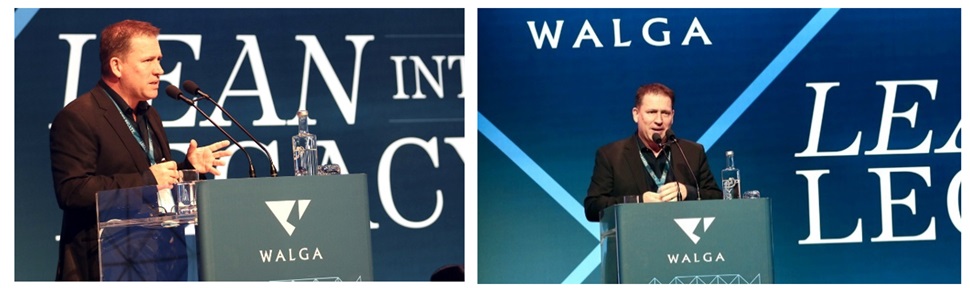
I also spoke about ALGA’s advocacy and research over the past year. At the heart of it all, we’re here to ensure the voices of your councils are heard by key decision-makers in Canberra.
I’m looking forward to presenting to Victorian councils and leaders at the MAV conference in Melbourne on 9 October.
Minister King to attend 2025 Roads Congress
I’m excited to announce Federal Infrastructure, Transport, Regional Development and Local Government Minister Catherine King will be our special guest speaker at the 2025 National Local Roads, Transport and Infrastructure Congress in Bendigo.
Minister King will deliver the Minister’s Address on 12 November and outline the Federal Government’s national agenda and recent reforms on roads, transport and infrastructure.
The Congress theme for this year is Driving National Productivity, with a strong emphasis on local roads, including funding, maintenance, and infrastructure, as well as discussing how we can support the national productivity agenda.
See the program, featuring guest speakers, and register now.
2026 National State of the Assets
Finally, I encourage all councils across Australia to participate in the 2026 National State of the Assets (NSoA) survey, which you can access here.
We have again partnered with the Institute of Public Works Engineers Australasia (IPWEA) to gather data and asset information from councils for the 2026 NSoA report.
I urge everyone to participate in the NSoA survey – which takes less than an hour to complete – as it provides a valuable and comprehensive evidence base for advocating for better roads and infrastructure funding in the future.
The final report and summary are expected to be released mid-next year.